

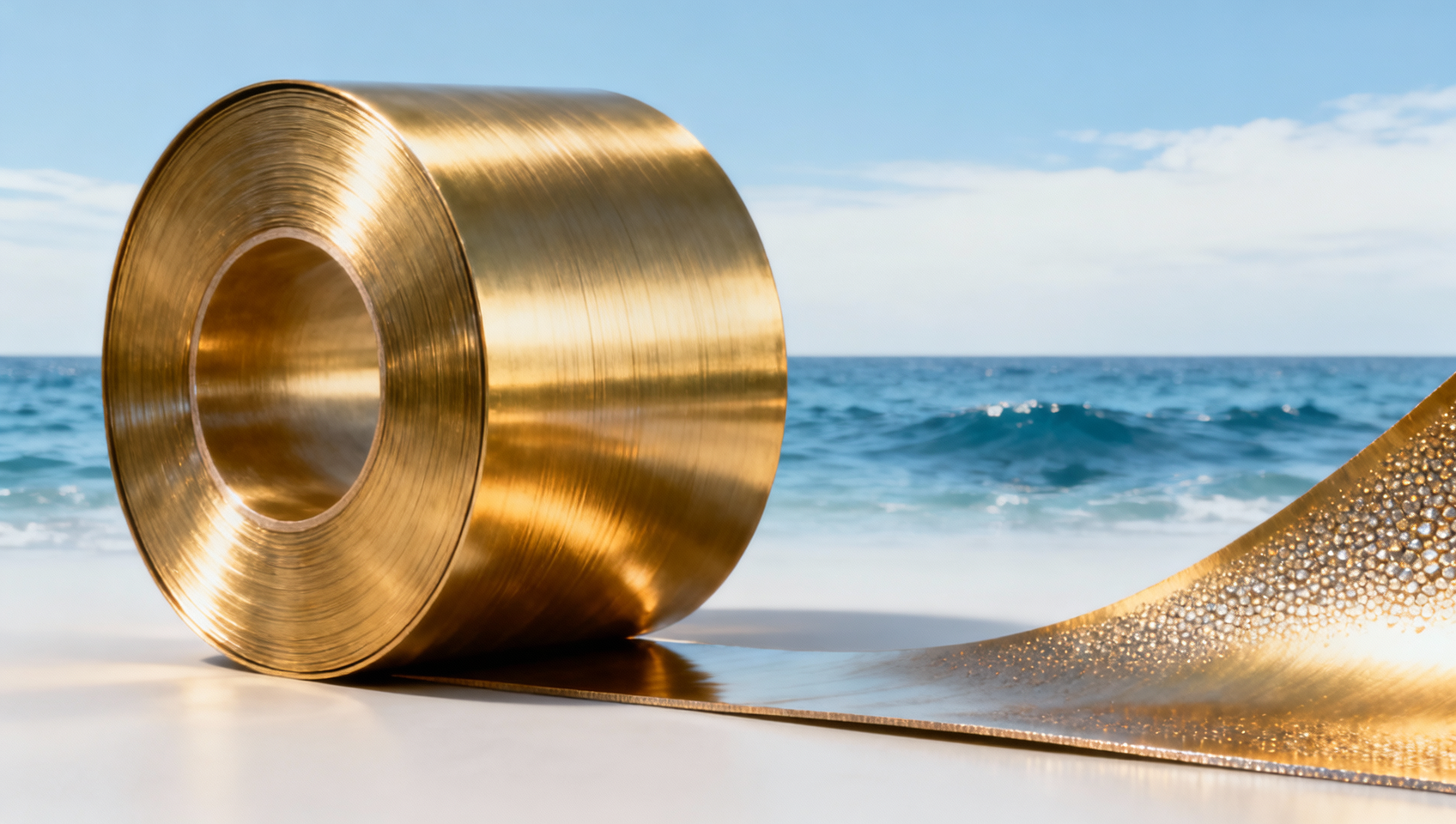
Brass coil is widely specified in marine applications for its corrosion resistance and workability—but dezincification remains a critical concern in aggressive seawater environments. While traditional brass alloys (e.g., C26000) are vulnerable, modern high-performance brass coils—often alloyed with arsenic, antimony, or phosphorus—significantly suppress selective leaching. This article evaluates whether dezincification is still a material risk today, comparing legacy vs. ISO-qualified brass coil alongside copper pipe and aluminum coil alternatives. As Shandong JintaiLai Steel supplies certified marine-grade brass coil to global projects, we provide technical clarity for engineers, procurement teams, and project managers assessing long-term reliability and lifecycle cost.
What Is Dezincification—and Why Does It Matter in Marine Brass Coil?
Dezincification is a form of selective corrosion where zinc is preferentially leached from brass, leaving behind a porous, copper-rich residue with severely compromised mechanical strength. In seawater—especially at temperatures above 25°C and with stagnant or low-flow conditions—the risk intensifies due to chloride ion concentration, oxygen availability, and biofilm formation.
Legacy brass coils like UNS C26000 (70/30 brass) exhibit measurable dezincification after just 6–12 months in static seawater immersion tests. Failure modes include pitting, cracking under stress, and sudden wall thinning—particularly at weld seams or crevices where local chemistry shifts occur.
Modern marine-grade brass coils mitigate this through controlled microalloying. Arsenic (0.02–0.06 wt%), antimony (0.01–0.04 wt%), or phosphorus (0.01–0.05 wt%) forms protective intermetallic barriers at grain boundaries, reducing zinc dissolution rates by up to 85% in accelerated ASTM B117 salt-spray testing.
How Do Modern Alloys Compare Against Legacy and Alternative Materials?
Selecting the right coil material requires balancing corrosion resistance, mechanical performance, fabrication ease, and total cost of ownership. Below is a comparative assessment across four key dimensions for marine service life expectations of 10–25 years:
Shandong JintaiLai Steel’s ISO 9001-certified brass coil production includes full traceability of alloy composition, heat treatment logs, and third-party corrosion testing reports. Every batch undergoes ASTM B858 dezincification screening prior to shipment—ensuring compliance with ISO 6509-1 and EN 13344 standards for marine service.
Procurement Checklist: 5 Critical Factors When Sourcing Marine Brass Coil
For procurement professionals and project managers, selecting the wrong brass coil can trigger costly rework, warranty claims, or premature system failure. Use this validated checklist before finalizing supplier evaluation:
- Verify mill test reports confirm arsenic or antimony content within 0.02–0.06 wt% range—not just “dezin-resist” labeling
- Confirm coil is supplied in ASTM B135 temper H02 or H04 (not fully annealed), ensuring minimum UTS ≥ 450 MPa and elongation ≥ 12%
- Require documentation of post-fabrication stress relief (if bending/welding planned), especially for coils thicker than 1.5 mm
- Validate packaging meets ISO 8502-3 requirements for chloride-free transport—critical for delivery to coastal ports in Southeast Asia or the Middle East
- Ensure supplier offers batch-level certification matching your project’s QA/QC protocol (e.g., DNV-GL, ABS, LR)
Shandong JintaiLai Steel supports all major marine certification frameworks and delivers standard brass coil orders within 7–15 days from PO confirmation—leveraging our integrated coking-to-rolling production chain and dedicated export logistics hub in Qingdao.
Why Choose Shandong JintaiLai Steel for Certified Marine Brass Coil?
With 17 years of steel manufacturing expertise and ISO 9001 certification, we deliver more than raw material—we deliver engineered confidence. Our brass coil production integrates sintering, EAF steelmaking, continuous casting, and precision cold rolling—all under one roof—eliminating cross-supplier variability and enabling real-time process control.
We serve over 40 countries—including demanding markets like Norway, Canada, UAE, and Singapore—with full documentation packages: EN 10204 3.1 certificates, Mill Test Reports (MTRs), and corrosion validation data per ASTM G31 immersion testing. For urgent or custom projects, our engineering team provides rapid alloy consultation, dimensional optimization, and logistics coordination across 6 major global shipping routes.
Contact us today to request: (1) Technical datasheets for UNS C68700/C69300 brass coil, (2) Sample coils with full MTRs, (3) Project-specific lead time and FOB Qingdao pricing, or (4) Support for your upcoming ABS/DNV-GL survey documentation package.
Related Posts
Online Message
Please give us a message