

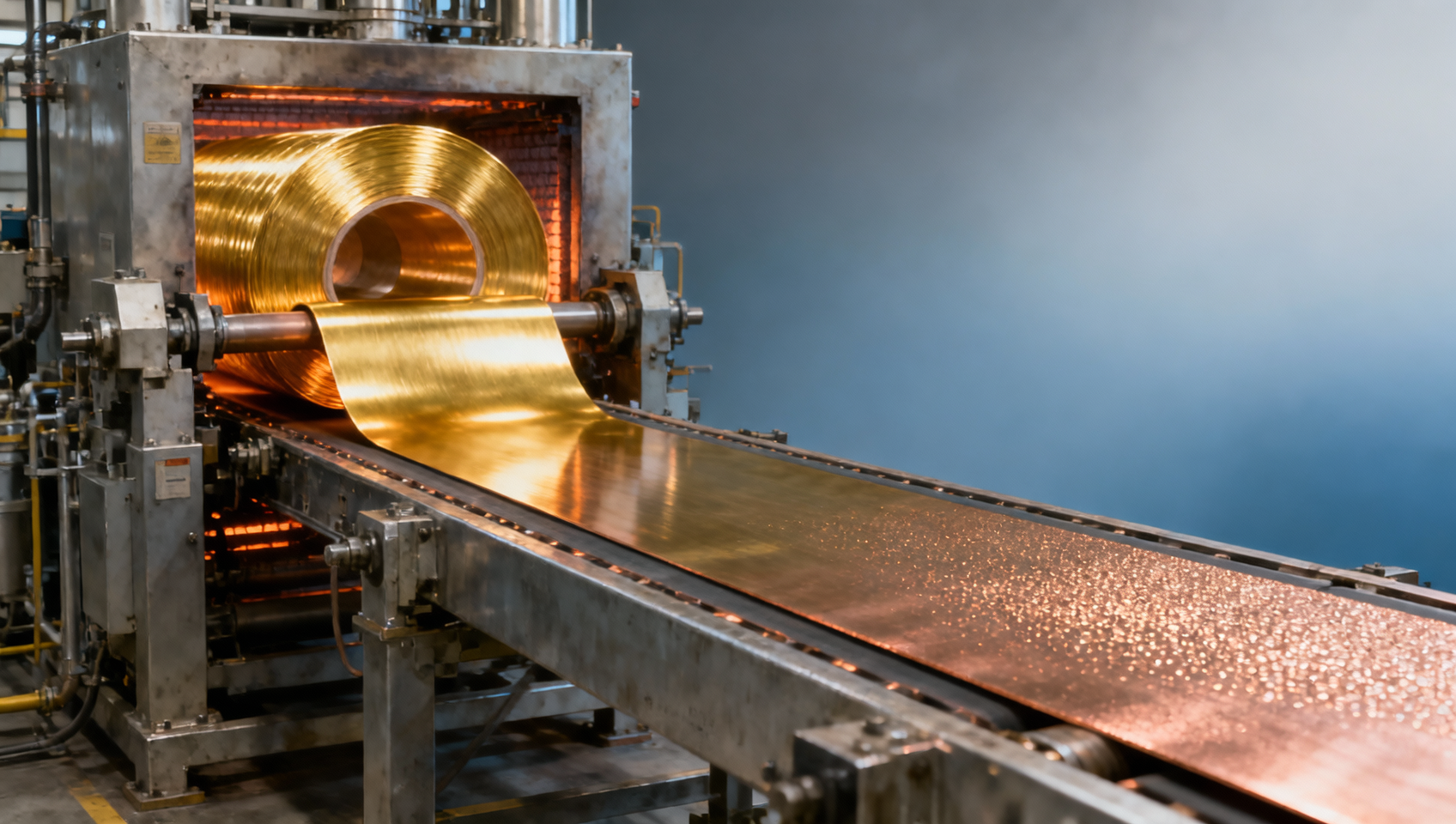
Precise brass coil annealing temperature ranges critically influence springback behavior—small deviations of just 5–10°C can significantly alter formability, dimensional stability, and end-product performance. While copper pipe and aluminum coil applications often dominate discussions on non-ferrous thermal processing, brass coil demands unique thermal protocols due to its zinc-copper composition and complex phase transitions. For engineers, procurement specialists, and steel fabricators at Shandong JintaiLai Steel Co., Ltd.—a certified ISO9001 producer of premium brass coil and other high-grade steel products—understanding these narrow, material-specific annealing windows is essential for quality control, cost efficiency, and downstream reliability.
Why Small Temperature Deviations Trigger Large Springback Shifts
Brass (typically Cu-Zn alloys like C26000 or C27000) exhibits distinct solid-solution strengthening and recrystallization kinetics. Unlike pure copper, its two-phase α + β structure means annealing must precisely target the α-phase homogenization zone (380–420°C) or full softening range (480–550°C), depending on final application requirements.
A deviation of only ±5°C shifts the nucleation rate of new strain-free grains by up to 30%, directly affecting dislocation density recovery. At 415°C vs. 425°C, tensile elongation may vary from 62% to 54%, while yield strength drops from 145 MPa to 128 MPa—altering springback angles by 0.8°–1.3° in precision bending operations.
This sensitivity is amplified during continuous annealing of coils (e.g., 0.15–0.8 mm thickness, 600–1200 mm width), where furnace zone uniformity must hold ±3°C across 1.2 m width to prevent edge-to-center property gradients. Shandong JintaiLai’s ISO9001-certified annealing lines use dual-zone PID control with real-time infrared pyrometry and 12-point thermocouple mapping—ensuring ≤±2.5°C variation across batch runs.
Key Thermal Transition Points for Common Brass Grades
The table confirms that higher-zinc grades require tighter thermal control. For C36000, exceeding 493°C risks localized β-phase grain coarsening—increasing springback scatter by 22% in repeated U-bend tests. Shandong JintaiLai validates every coil lot using ASTM E8/E8M tensile testing and springback angle measurement per ISO 7438, with full traceability to furnace log data.
How Fabricators Can Mitigate Springback Variability in Procurement
Procurement teams often overlook thermal history documentation—yet it directly impacts downstream tooling life and scrap rates. A 0.5° springback shift increases die wear by 17% in high-volume stamping (≥500,000 parts/month) and raises rework costs by $0.18–$0.42 per part in automotive trim applications.
Shandong JintaiLai provides certified thermal process reports with each brass coil shipment, including: (1) furnace zone temperature logs (recorded every 15 seconds), (2) cooling rate profiles (target: 5–12°C/s to avoid residual stress), and (3) post-anneal microhardness maps (HV0.2, ±3 point variation across width). This enables predictive springback modeling in software like AutoForm or PAM-STAMP.
For project managers specifying brass coil, we recommend requesting three critical documents before PO issuance: (1) batch-specific annealing certificate, (2) grain size report (ASTM E112, target: ASTM 6–8), and (3) surface roughness verification (Ra ≤0.4 μm for fine blanking).
What Technical Evaluators Should Verify Before Sample Approval
- Confirm annealing was performed in a nitrogen-hydrogen (N₂–H₂) atmosphere (≤10 ppm O₂) to prevent dezincification—verified via SEM-EDS on cross-section samples.
- Validate tensile test specimens were cut parallel to rolling direction (not transverse) to reflect actual springback anisotropy.
- Require springback angle data from standardized V-bending tests (ISO 7438, 90° die, 0.5 mm radius punch) at three positions: center, ¼-width, and edge.
- Check for consistent temper designation: H0 (fully annealed) requires ≥95% recrystallization; H14 (quarter-hard) requires controlled partial recovery—both demand distinct thermal windows.
Why Shandong JintaiLai Delivers Consistent Brass Coil Performance
As an ISO9001-certified integrated steel producer, Shandong JintaiLai controls the entire value chain—from raw material sourcing (zinc purity ≥99.995%) to final coil packaging. Our brass coil production uses vacuum-melting furnaces with electromagnetic stirring, ensuring ±0.15% Zn content tolerance across 15-ton heats.
Unlike traders or converters, we operate dedicated brass annealing lines with 7-zone continuous furnaces (capacity: 3–8 tons/hour), equipped with automatic tension control (±0.3 kN) and laser-based flatness monitoring. This allows us to guarantee springback consistency within ±0.4° across 1,200 mm widths—critical for Tier-1 automotive suppliers requiring PPAP compliance.
With export experience across 30+ countries—including stringent markets like Germany (DIN EN 1652), USA (ASTM B36), and Japan (JIS H3250)—we align all brass coil certifications to regional mechanical and thermal standards. Lead times average 12–21 days for standard grades (C26000/C27000), with rush options available for urgent projects (7–10 days with priority scheduling).
Get Precise Brass Coil Specifications & Thermal Validation Support
If your application involves tight-tolerance bending, deep drawing, or high-cycle fatigue components, contact our technical sales team for: (1) customized annealing parameter sheets aligned to your springback tolerance (±0.2° to ±0.8°), (2) free sample coils with full thermal documentation, (3) ASTM/ISO-compliant test reports, and (4) logistics coordination for delivery to North America, EU, Middle East, or Southeast Asia ports within 14–21 days.
Specify your required grade, thickness (0.10–2.00 mm), width (500–1500 mm), temper (H0, H14, H24), and target springback angle—we’ll deliver validated brass coil with guaranteed thermal consistency and full traceability.
Related Posts
Online Message
Please give us a message